Designer: Reiner Knizia
Artist: Lukas Siegmon
Publisher: Pegasus Spiele
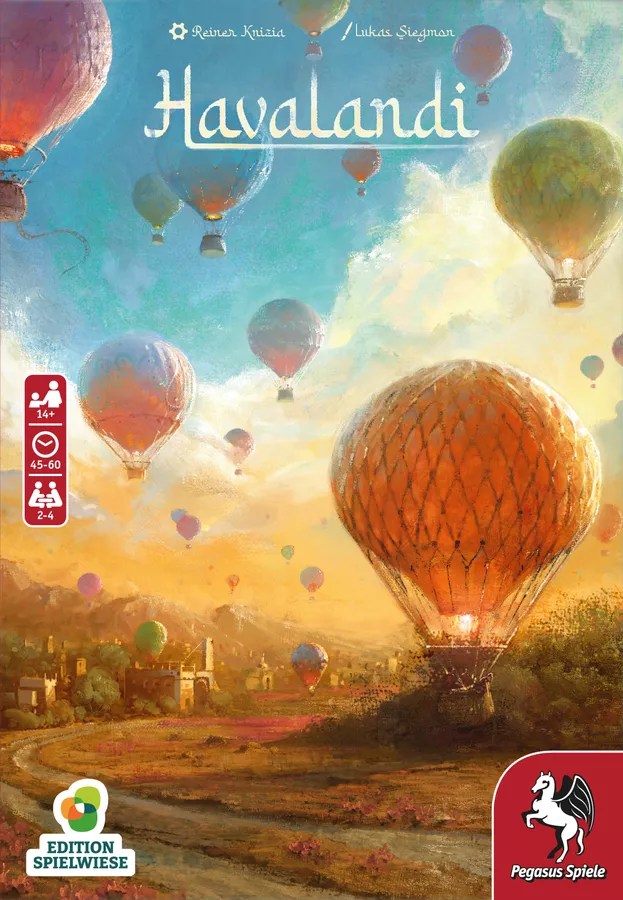
A new design from Reiner Knizia, my favorite designer of all time, will always grab my attention. It does not mean an automatic purchase, but I usually will try to get a few plays under my belt before deciding if I want it in my collection. Havalandi popped up unexpectedly on my radar without any warning and the game sounded like a typical Knizia that feels a bit more abstract judging by the rules. It is a medium light game that plays with up to four players. The theme of balloon flight in Havalandi is somewhat interesting because I struggled to read up on Havalandi. A Google search revealed very little information on what I thought was a location in Turkey but Google translate revealed that the word means “Take off” or “Take to the skies” in Turkish. Likely, the word is tied to hot air ballooning at Cappadocia, a famous scenic region in Turkey where people go to catch the sunrise. Photos show lots of balloons dotting the skyline. Quite a gorgeous scene.
Simple action selection: Move balloon, place one token in a legal space. Rinse and repeat
The main board of Havalandi is a triangular space constructed from hexes where players place tokens of their color to symbolize the staging grounds for their balloon launch. There are three terrains on the hexes: meadows, tulip fields and sand dunes. Amongst the terrain is a stretch of gravel road hexes linking the top of the map to the bottom. In addition, there are a seven pavilions scattered around the edges of the map. The location for placement of tokens is pretty novel – one must roll a die and move a large balloon construct around the edges of the map and where the balloon stops, the two arrows pointing outwards from the balloon will determine the allowable rows for placement. Tokens can be placed in any hex on the two rows, or one space away from a pre-exisiting player token so long as it is on the same terrain type. That is basically it. From these simple rules for placement, players interact and compete to claim the most favorable terrain for forming clusters of balloon sites for launches that will score points.
Three types of in-game scoring and one at the end, but all are interlocking and purposeful.
In Havalandi, points are scored in several ways. One way is to form a chain of launch sites that span the different terrain types. For each terrain type, players will score four points when the balloons are launched by flipping the tokens over. Importantly, once the network of launch sites are formed, they must link back to the gravel road in order for the balloon chain to be activated. Without anchoring at least one token at the gravel road, the balloons cannot be launched. To further enhance scoring, independent scoring chains can be formed on both sides of the gravel path and when launched, balloons from both connected chains can be scored . Another way of scoring is by forming at least a cluster of three tokens on the same terrain type. Players score one point per token and each additional placement on the same terrain that enlarges the cluster will be scored again. Finally, a token placed adjacent to a pavilion will score 3 points with a scoring bonus if a player can place a token adjacent to all the pavilions. The game also has an end of game scoring. Two scoring cards are drawn and the end of game criteria will earn players additional points. Some of the scoring cards are individual achievements while others are a competition for specific categories (e.g. largest balloon cluster).
Short and long-term scoring objectives collectively drive individual token placement, but opportunistic blocking is needed to inject tension and enhance player interaction
It does not take very long to teach Havalandi, but like all Knizias, you cannot grok the game by reading the rules alone. There is a fair bit of emergent play that comes out from token placement. Most of Knizia’s games structured in such a way that forces a player to make hard choices based on the board state. The complexity comes not from action selection, because they are usually simple, but from reading the board, understanding your opponents’ choices and making an optimal placement for scoring, all the while looking for creative opportunities to mess up your opponents all in one fell swoop. For example, in choosing a launch site, one is torn with cashing in on scoring immediate points (cluster or pavilion scoring) vs. setting up a longer chain for future scoring. Should you go for the easy points or risk building a longer chain? Conventional wisdom suggests that long term planning tend to reap greater rewards. However, this can be situational because if cluster scoring is unopposed and there is plenty of room for growth, then with each additional token placed, the cluster grows, scoring snowballs and it can become a viable major scoring mechanism. Similarly, pavilion scoring may seem weak, but if all the pavilions are scored, one can earn bonus points. Some of these decisions will also boil down to what your opponents are doing, the spatial constraints and also, end of game scoring. Setting up a long chain can be rewarding, but will invite conflict. Opponents will certainly try to interfere. Havalandi can have a fair bit of negative interactions and conflict. Even though it is possible to “play in your own courtyard” throughout the game, it is most certainly beneficial to play aggressively and counteract opponent moves at specific choke points to prevent scoring. The strategy to pursue a certain path must be dictated by how the game develops over the course of play. An eye must also be kept at the end-game scoring criteria. It will govern your decisions throughout the entire game. In fact, after a few plays, I am convinced that the end of game scoring will drive one to preferentially choose certain modes of scoring. Finally, to spice things up, there are three special tokens that alter the placement rules for everyone. First is a token that can be played on any location, ignoring balloon movement. The second allows stacking on top of a preexisting token the map. This allow one hex on the map to be shared by two player pieces. The third special token allows double placement. These special tokens will open up opportunities and also keep players on their toes. It is a wonderful addition that reminds me of Knizia’s Samurai.
Theme and narrative is weaker than other recent Knizia designs
Havalandi’s theme is probably one of the weakest ones I have played recently from Knizia. No doubt, most of Knizia’s games are abstracts but he usually does a great job of picking a narrative that ties together the simple mechanisms. In Havalandi, having the large prop balloon circling the outer edges of the map is impressive but I find the narrative a bit disjointed from token placement. Why do I need a balloon to designate the launch site and how does that tie into the scoring mechanism? I cannot make that connection between the action and the outcome. While theme should not distract from play, it can certainly help in the learning process and this is not a strong suite for Havalandi. Nevertheless, this is a somewhat minor criticism as the game works fine and as eluded, is not hard to learn or teach.
Final thoughts
Havalandi has all the elements of a game that I enjoy. Easy to teach, easy to play and with lots of depth and interaction. Our first few plays have been positive but I noted that in some of our sessions, the interaction has been a bit weak. Games have been relatively low conflict with very little interference between players. Folks did not block much and went about their merry way executing their plans. That is because when faced with the possibility of blocking others or improving individual board state, most chose the latter. While these low conflict games are not terrible, they felt more solitaire-esque, a facet of game play which I am increasingly trying to avoid. In 3 player settings, aggressive blocking usually ends up helping the third player as you “sacrifice” a turn doing so without making any progress on developing your own network. Which is why I wonder if most of us chose the path of least resistance. With two players, some of the sites on the board are pre-seeded with tokens to block easy placement. The game, being zero sum and all, was more competitive with two. Since the board comes in an A and B side – with the B side having a forking gravel road and potentially more high scoring connections, I can imagine the game to be a little bit more tense at 3-4 player counts. That remains to be seen. Overall, I am upbeat about Havalandi and will continue to probe the game in upcoming sessions to see if it is worthy of staying in my collection.
Initial impression: Good
Discover more from The Dao of Board Gaming
Subscribe to get the latest posts sent to your email.
 The Dao of Board Gaming