Designer: Wolfgang Kramer
Artist: Franz Vohwinkel
Publisher: Ravensburger
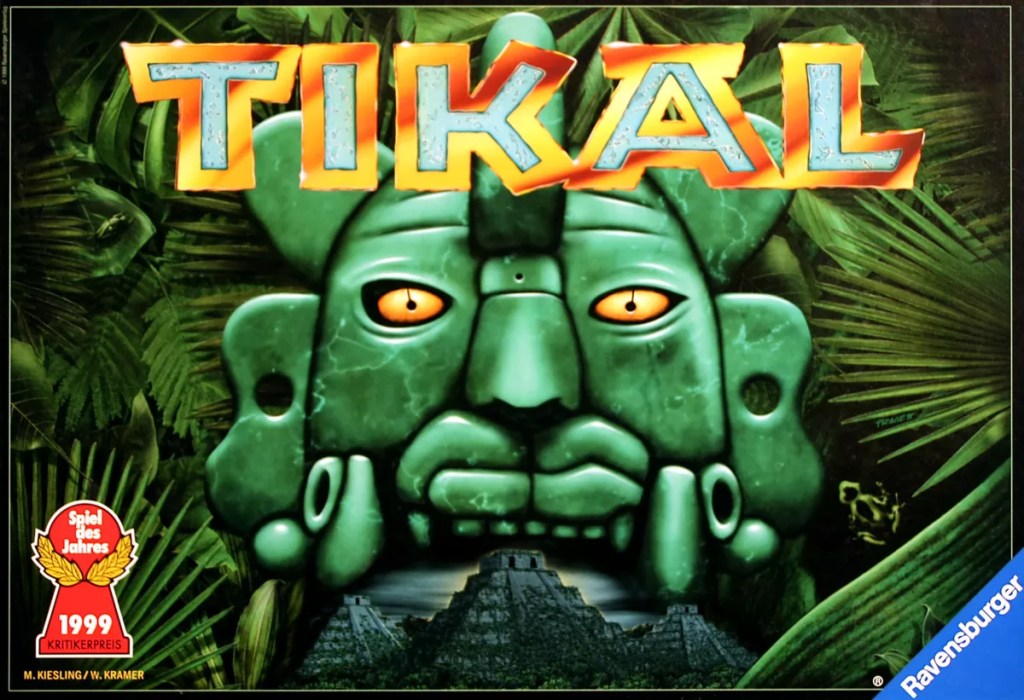
By the time this article is out, Tikal would be celebrating its quarter century anniversary with the upcoming publication of Tikal Legends, a spiritual successor of the game by the original designers Wolfgang Kramer and Michael Kiesling that pays homage to the OG. That is how long ago this game has been in our consciousness and how much gaming has evolved since. For many veterans of the hobby, Tikal has never really exited the stage despite the fact that the game is polarizing. You are likely to find hobby gamers who feel strongly about the game one way or another. For me at least, Tikal is one of the defining masterpieces in Mr. Kramer’s ludography and will remain in my collection for years to come.
So what is it that makes Tikal so polarizing? Well, for starters, the action point mechanism that drives Tikal was never full embraced and is now largely defunct. Untouched by designers for many years and shunned by gamers, the mechanism is notorious for inducing analysis paralysis, turning the pace of any game into molasses. In spite of the controvery, the designers still squeezed out three additional games using the same mechanism – Java, Mexica and Torres before it faded from existence. Collectively, Tikal, Java and Mexica are fondly known as members of the Mask Trilogy since the original box cover features a gorgeously illustrated mask linked to these civilizations. Torres being the fourth entrant in this trilogy uses the same mechanism, but is thematically seen as an outlier. Hence, Torres is often lumped together whenever the Mask trilogy is mentioned.
Actions require action points and players are free to utilize ten actions points to craft a combination of moves each turn.
In Tikal, players are bestowed 10 action points each turn to spend as they see fit across a select number of actions, each costing a certain number of points. Using these action points players will perform a combination of actions to move their explorer pawns around the jungle terrain, collecting artifacts or clearing the undergrowth to reveal temple layers. Since Tikal is an area majority game, all these actions funnel towards claiming temple majorities with player pawns and set collection of artifacts. To start off each turn, players must first draw a face down hex tile from the reserve and place it on the shared board. Each vibrantly illustrated hex tile can have one of several features including artifacts, abandoned temple levels or even an empty clearing. Carefully interspersed between the stack of hex tiles are three volcano tiles that trigger mid-game scoring. After a tile is flipped over, it must be placed on the board starting closest to the camp site and adjacent to pre-exisiting tiles. In this way, as the game progresses, the jungle landscape will be slowly pieced together tile by tile, inching further away from the starting campsite and deeper into the jungle. After tile placement, the active player then uses the 10 action points to perform actions.
Among some of the actions include introducing new explorers to the campsite (1 action point), staging a new campsite in a clearing to extend the range of explorer movement (5 AP) and also moving explorers from one tile to the next (1 AP or more). However, moving explorers between tiles depends on the number of waypoint stones straddling the junction between the two tiles. Not all edges of a tile will have waystones and those that have will contain between 1-3 stones. Players can only traverse between tiles if there is at least one stone and hence, movement values can range between 1-6 action points when two tiles are adjacent to each other, making some movement particularly costly. Much of the game hinges upon how tiles are placed to strategically sequester valuable temples or at least making explorer movement very costly for opponents. Creative tile placement along with timely building of new campsites on empty clearings allow players to carve out a niche whereby access to certain tiles with high-value temples or those that contain artifact discs require using a lot of action points to reach, except by the active player.
Sequential area majority scoring means that control of temples are tactical and transient.
Beyond manipulating the terrain, action points are also used to uncover temple levels. Early on, tiles with temples will start at the base value of 1. Temple layers can then be uncovered by spending action points (2AP per level) to stack new temple tiles on the base, up to a maximum level of 10. This simulates explorers clearing the undergrowth to reveal more of the temple. However, temple levels are limited in supply so that not all temples will reach the maximum height. In fact, there is only a single level 10 piece available for the entire game. Each temple level requires at least one explorer to uncover and each turn, only two temple levels can be uncover at each hex location. As temple levels are uncovered and grows vertically, the temple becomes more valuable as the temple level are also points. During each of the four scoring phases triggered when a volcano tile is revealed, temple majorities will be calculated individually and sequentially after each player uses the 10 action points. This matters as the sequential scoring of points for players means that even though the first player has earned majority and scored the temple points, subsequent players with a stake on the temple can still move more explorers into the same hex to establish a new majority. This surprisingly dynamic scoring methodology completely shifts the traditional perspectives of how area majority is obtained and maintained during scoring. Since loss of majority does not retroactively lead to losing points, the majority only matters in a more transient way. Essentially, after scoring is done, losing a majority is not as critical. If a player desires to maintain a stranglehold on a valuable temple, they can convert all the pawns into a temple guard (5 AP) which will prevent other players from scoring for the remainder of the game. However, each player is allowed to post only two guards the entire game and it comes at the cost of removing all pawns stationed at the temple when the guard is installed.
Besides temple scoring, set collection of artifacts will also contribute a large chunk to the final scores. Certain hexes when placed, will indicate presence of 3-4 artifact discs which can be excavated (3AP/excavated disc). Players are encouraged to form sets of three similar artifacts to earn maximum points either by being lucky during excavation or by exchanging excavated discs with other players who may have found the necessary pieces to complete a set. Artifacts can only be swapped (3AP) if a player already owns two of the three discs and the exchange cannot be denied by others. Similarly, other players are not allowed to snatch or tear apart a collection if the owner hold at least two of the three artifact tiles. A completed set of three artifact discs can earn 6 points for each scoring round while a partial set of 2 still earns 3 points.
Deciding how to allocate action points can be liberating for some, but will bog down the decision process for others.
The freedom to use action points to carry out actions ends up being both a boon and also a source of frustration for players. The action point system encourages a somewhat open sandbox style of play, but will be paralyzing for some players confronted by an unlimited variety of moves afforded by the same 10 action points. This is especially true for players who feel compelled to maximize every single move to score points. The situation can become unbearable if a bunch of players all suffer from analysis paralysis which will dramatically increase total play time. The action point mechanism really amplifies the penchant for players to over analyze, even for those of us who normally make efficient moves. To play Tikal as intended is to play more intuitively. Instead of mapping out every move and to micromanage, it is much better to get a sense of what are the optimal moves based on the current board state and boldly take the next step. Do not look back with regret and just trust your instincts. It is of course likely that certain moves are suboptimal, but in a game like Tikal, that is to be expected. Otherwise, the alternative can be disastrous for the overall enjoyment of the game. No doubt this is the one reason why the AP mechanism is no longer in vogue.
Tikal is a “high conflict” game with brutal moves.
To the extent that Tikal won an award for being a family game, the game play can be brutal. The fight for area majority is always intense and the AP system affords the flexibility for players to make unexpected moves, cutting the feet off opponents by claiming unexpected area majorities. One example is to jump on a poorly defended but valuable temple tile and installing a guard to squeeze out the resident explorers and to lock them out from future scoring. When timed expertly, the aggressor can wait until the temple is developed before jumping in to secure the majority. Another example of a “mean” play is to place new hex tiles to box out specific campsites by making explorer movement extremely costly. These plays will be jarring for some and delicious for others and not for the faint of heart.
Tile auctions lengthens play but provides additional tactical moves
The auction for tiles is recommended for expert level play, but can really be instituted at any level. The idea is to used points accrued during the game as currency to pay for the rights to select tiles for placement. The downside for this variant is the further lengthening of play time which can be substantial if using the auction methodology outlined in the rule book. Fortunately, there are many auction variants out there that can be adapted to Tikal without really harming game play. In particular, we have tried and enjoyed the “For Sale” style of auction which is much faster. The auction for tile selection will add another tactical dimension during play, but it is debatable whether it is truly needed for a group of casual gamers. The choice is there and I think it highly depends on group composition, play styles and dynamics. The truth it, even without the auctions, Tikal is an already excellent game.
Final thoughts
Despite the big drawbacks in the AP system, the mechanism lends itself to creating epic moments in the game that I really appreciate. Perhaps it is the high conflict nature of the game that creates these moments? The game might be a quarter century old, but some elements of Tikal remain fresh even after all these years of playing. For one, the way sequential scoring is set up in Tikal is unique and allows for a different perspective for how area majority scoring works. Unlike a single scoring phase, the individual scoring steps makes everything slightly more transient. Going first in scoring has a huge advantage as majority ownership is easier to achieve. Coming in later during scoring is more challenging as other players may have already established a stronghold which then requires more to overcome. However, gaining temporary leverage in an area is sometimes enough to score well and after the scoring round is over, explorers can be redistributed to other tiles. Yet, the game also has longer-term scoring objectives which includes depriving others the opportunity to score high value temples. Judicious use of the temple guard to lock-in scoring at opportunistic moments can really swing the tide for scoring and victory. There is one downside to this type of scoring, and it is that it lengthens the game. Each player gets 10 AP to carry out actions before scoring which slows down the flow of the game.
Despite the tussle for temple control, I think the biggest swingy factor in the game belongs to the set collection of artifact discs. Getting to place a hex with artifact discs is already somewhat luck driven (unless the tiles are auctioned), as is the revealing of the excavated artifact discs. Yet, to partake in none of the excavation process would be a mistake as piecing together a set or even a partial set early during the game can snowball during scoring. A complete set is worth 6 points and if one is lucky enough to get a set early on, that is 24 points over the course of 4 scoring phases. Perhaps the designer knew about this and in order to mitigate the luck of drawing hex tiles with treasures, they introduced an auction variant for tile selection.
I have always enjoyed Tikal despite its negatives. Perhaps I have been lucky to play with folks who play more intuitively and do not overanalyze moves. Even at this brisk pace, Tikal can be slow and I think this is the only sign that the game design has aged. Likewise, the luck in set collection matching and swapping is also something that you do not see often in modern games and they are perhaps a remnant of older Euro designs where there is always a strong undercurrent of risk in a tile flip or roll of dice without built-in mitigating opportunities.
Impressions: I like it. That said, among the other Mask trilogy games, Tikal comes in last. The AP mechanism in Java and Mexica is similar, but the gameplay feels tighter and more streamlined. Nevertheless, after a quarter century since its publication, Tikal can stand tall. The game play is definitely on a higher, expert level and while families can play, I think kids will be competitively at a disadvantage. Moreover, the aggressive play can be a turn off for some, making this a less family-oriented game. Finally, Tikal should also be avoided by those who are extremely prone to analysis paralysis. Otherwise, I highly recommend this game especially for new comers to the hobby who have never been exposed to the action point mechanism.
Discover more from The Dao of Board Gaming
Subscribe to get the latest posts sent to your email.
 The Dao of Board Gaming